By Megan L. Fork, PhD, Assistant Professor of Biology, West Chester University and Chief Scientist, Goose Creek Alliance. From the Green Team’s March 2026 newsletter.
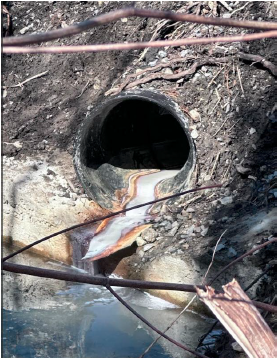
Like many of my neighbors, I was appalled to learn about the [Feb. 28, 2026; photo by Courtney Finneran] chemical spill in Goose Creek over the weekend. I’ve taken countless students to this creek to teach them how to measure stream flow, monitor water chemistry, and assess biological integrity. My family and I also live only a block from the stream. Goose Creek is not an abstract teaching tool or a line on a map, it’s part of my daily life and the heart of our local ecosystem.
Thanks to intrepid local reporting and the quick work of the Pennsylvania Department of Environmental Protection, we now know the identity of the substance that entered the creek: a proprietary product known as Long Duration Foam AC-645, mixed with chlorinated water. Unfortunately, what we still don’t know is what is actually in this chemical formulation, or what effects it might have on the environment or on the people who come into contact with it.
As an environmental scientist, my first stop when evaluating a chemical is the Safety Data Sheet, or SDS, the international standard for communicating risks to people and ecosystems. But when I located the SDS for Long Duration Foam AC-645, I was met with line after line of information “not available.”
This is not an oversight. It is the predictable outcome of how chemical safety regulations work in the United States.
Under the Toxic Substances Control Act (TSCA), companies are not required to disclose the full contents of proprietary chemical mixtures. They are also not required to provide comprehensive safety data for new products before those products enter commerce. In practice, this means chemicals are often used widely for decades before we understand their risks and we only test them when something goes wrong over and over.
Regardless of its contents, this spill should never have reached Goose Creek. Property owners who store industrial chemicals have a clear responsibility to prevent spills from reaching our water. This includes implementing, testing, and regularly maintaining secondary containment systems that reliably capture leaks before they reach soil or waterways. If these safeguards are ignored or allowed to deteriorate, our shared ecosystems suffer the consequences. Ensuring that chemicals stored on one’s land do not pollute the community is something we should expect and require of our neighbors.
 West Chester Green Team