All our activities promote community and common action. The Green Team is a chapter of Transition, an international movement founded in 2005 that encourages communities to start local in addressing the big challenges we face. By coming together, we are able to find solutions to the problems of our time. We seek to nurture a caring culture focused on supporting each other, both as groups or as wider communities.
In practice, we are cleaning up the environment, reclaiming the economy through initiatives such as community gardening, sparking local leadership by mentoring youth, interacting with local institutions, educating through camps, films and forums, and weaving webs of connection and support. It’s an approach that has spread now to over 50 countries, in thousands of groups, in towns, villages, cities, universities, schools. Through WCGT, West Chester became a Transition Community in 2020. We hope you feel inspired to take part in this work and we’d be honored if you did!
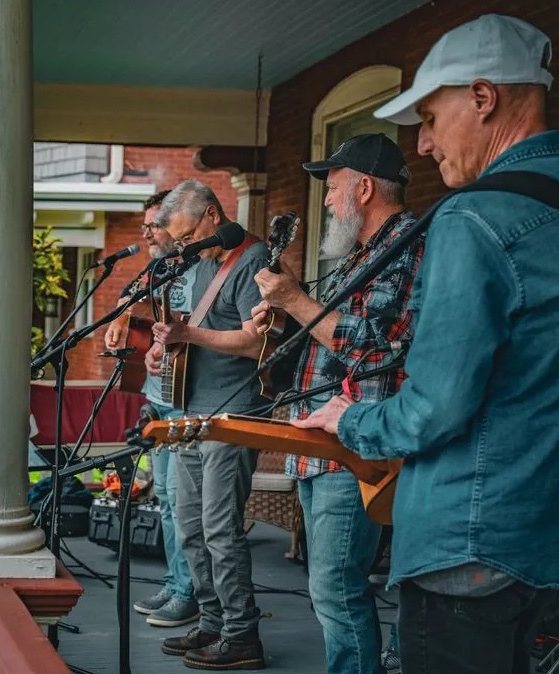
We have continued our efforts by expanding gardening opportunities, encouraging pollinator gardens throughout the area, working with West Chester Borough to reduce plastic use, and holding an annual music-centered community celebration in May, called West Chester Porchfest.
If you would like to help on planned future initiatives like Tree Equity (see more here) and History and Sustainability, please let us know!).
Recognizing that transition is not only in the physical world, we held series of workshops in fall 2023, Inner Transitions (Reflect / Respect / Reform / Restore: Honoring Our Essential Nature of Connection), conducted by Dawn Mazzone of Creative Economy Enterprises.
If you would like to get more information or volunteer to help out in any of these ongoing community programs, please contact us. If you would like to help these good causes financially, please donate.
History of West Chester Area Transition (WCAT)
West Chester Area Transition, an initiative of the WC Green Team, became fully functional early in 2021, with regular meetings, three programs underway, and two more in the planning.
In January, a group of Green Team leaders and friends engaged in a brainstorming activity following the guidelines of the international Transition movement, which asks: “What does your town need?” Out of this activity came five ideas which were discussed and narrowed down to three for 2021. That summer, Transition US notified us that it had approved the membership application of West Chester Area Transition.
We decided that the community needed more community gardens an we have added several. Over time, we have worked with Barclay Friends, the Lockard family and the Melton Center on this project.
As part of this outreach, the Green Team asked Barclay Friends and the Melton Center: “What can we do for you?” At Barclay we taught gardening skills to the staff, including growing herbs to be used in the residents’ dining hall. At the Melton Center in summer 2021, we provided children’s programming in eight evening events, including a planting activity, a folk tale about peaches from Japan, sessions on how pumpkins grow and on beneficial insects, and finally an ice cream party–with no-dairy options–along with stories from New Zealand.
Another early Transition initiative is Living Landscapes, in which a team led by Courtney Finneran piloted removing grass and planting pollinators. Living Landscapes has become its own complex of land-related activities; for more, see here.
Our other 2021 initiative was cutting down on plastics. One of Prof. Schraedley’s communications classes reached out to about 60 restaurants and businesses in the Borough and about plastics reduction in the context of the Borough’s Sustainable Storefronts initiative (see more details on that program here). For our overall Plastics initiatives, see here
You can read about WCAT on the TransitionUS site. See earlier updates on West Chester Area Transition’s work here and here. Read about other nearby Transition groups Phoenixville Area Transition here and Transition Town Media here.

From the overall Transition movement’s self-description:
Transition is a movement of communities coming together to reimagine and rebuild our world.
The international Transition movement began in 2005 in Totnes, England, and has since spread to over 1,200 communities in 50 countries around the world. Transition is about communities stepping up to address the big challenges we face by starting at the local level. We seek to nurture a caring culture, one focused on connection with self, others and nature. We are reclaiming the economy, sparking entrepreneurship, reimagining work, reskilling ourselves and weaving webs of connection and support. We are engaging in courageous conversations; extraordinary change is unfolding.
Every Transition Initiative is independently-run, responding to the unique challenges and opportunities that exist in our local communities. However, we are bound together by a similar outlook, a common set of principles, and a five-stage model for scaling-up our impacts over time.
Our Principles
We respect resource limits and create resilience
The urgent need to reduce carbon dioxide emissions, greatly reduce our reliance on fossil fuels, and make wise use of precious resources is at the forefront of everything we do.
We Promote Inclusivity and Social Justice
The most disadvantaged and powerless people in our societies are likely to be worst affected by rising fuel and food prices, resource shortages, and extreme weather events. We want to increase the chances of all groups in society to healthy and sustainable lives. For more on Environmental Justice, see CCEA here.
We Adopt Self-Organization and Decision-Making at the Appropriate Level
The intention of the Transition model is not to centralize or control decision-making, but rather to work with everyone so that it is practiced at the most appropriate, practical, and empowering level.
We Pay Attention to Balance
In responding to urgent, global challenges, individuals and groups can end up feeling stressed, closed, or driven rather than open, connected, and creative. We create space for reflection, celebration, and rest to balance the times when we’re busily getting things done. We explore different ways of working which engage our heads, hands, and hearts that enable us to develop collaborative and trusting relationships.
We Are Part of an Experimental, Learning Network
Transition is a real-life, real-time, global social experiment. Being part of a network means we can create change more quickly and more effectively, drawing on each other’s experiences and insights. We want to acknowledge and learn from failure as well as success – if we’re going to be bold and find new ways of living and working, we won’t always get it right the first time. We will be open about our processes and will actively seek and respond positively to feedback.
We Freely Share Ideas and Power
Transition is a grassroots movement, where ideas can be taken up rapidly, widely, and effectively because each community takes ownership of the process themselves. Transition looks different in different places and we want to encourage, rather than unhelpfully constrain that diversity.
We Collaborate and Look for Synergies
The Transition approach is to work together as a community, unleashing our collective genius to have a greater impact together than we can as individuals. We will look for opportunities to build creative and powerful partnerships across and beyond the Transition movement and develop a collaborative culture, finding links between projects, creating open decision-making processes, and designing events and activities that help people make connections.
We Foster Positive Visioning and Creativity
Our primary focus is not on being against things, but on developing and promoting positive possibilities. We believe in using creative ways to engage and involve people, encouraging them to imagine the future they want to inhabit. The generation of new stories is central to this visioning work, as are having fun and celebrating.
 West Chester Green Team