By Nathaniel Smith, from the September newsletter
Data centers, in the news every day, have suddenly become a leading issue in political debates. It is unusual for a largely environmental issue to receive so much attention. 70% of Americans worry about the environmental impact of data centers and 71% don’t want a data center constructed in their area; 74% of Pennsylvania voters would oppose a data center in their community.
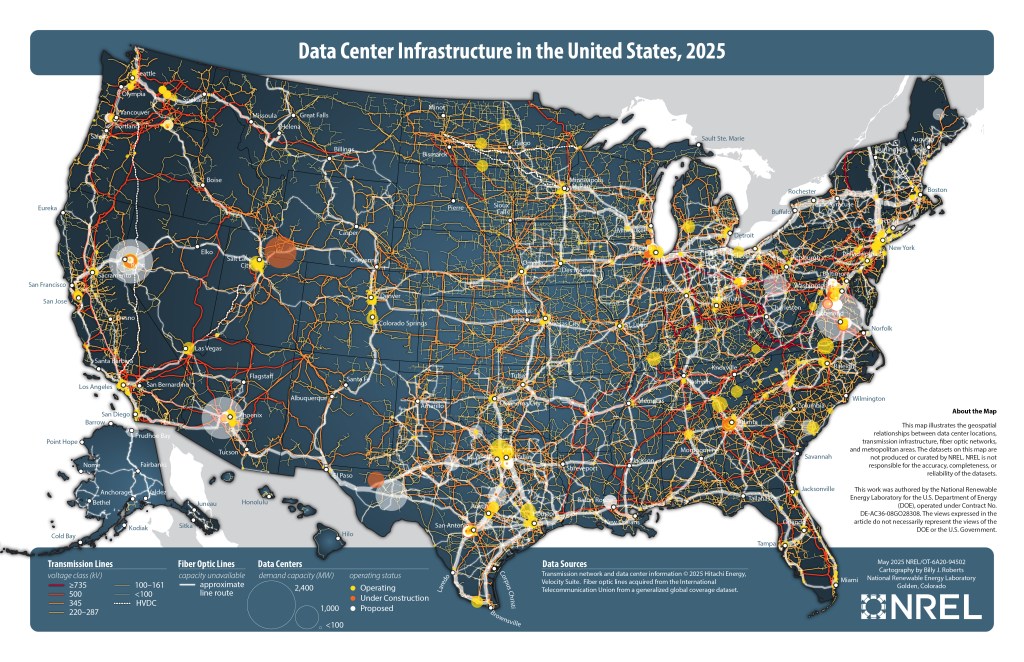
Data centers (AKA server warehouses) are concentrations of computer processing power driven largely by AI and cloud computing (basically, whatever isn’t stored on our own computers). Data centers can be free-standing or part of another commercial building. How many do we need, where do we need them, and for how long (will they, some day, go the way of the late lamented Exton Mall)?
Their downsides include:
• Large amounts of energy to power and cool the centers.
• A lot of water needed in cooling, depending on design.
• Noise and vibration, which many people living near data centers find intolerable.
• Air pollution from on-site generators, whether in permanent use or as back-ups.
• Taking up land that could be used for agriculture, housing, or other purposes.
Just as people have been noticing the storms, floods, droughts, deaths and diseases magnified by climate change, so they notice escalating electricity rates, water shortages and other problems caused by data centers.
At a time when Americans are struggling with inflation, home energy costs are a real concern. Even the US Congress has noted that “U.S. data center annual energy use in 2023 (not accounting for cryptocurrency) was … approximately 4.4% of U.S. annual electricity consumption” and “Some projections show that data center energy consumption could double or triple by 2028.”
Ideally, data centers would be far from residences and businesses but not in environmentally sensitive areas, use their own sources of renewable energy supplemented by battery storage, and have a water supply not in competition with residents and businesses. Maybe in exclusively industrial areas with big solar panels on large rivers would be good? That could be required; but regulations have been scarce.
The scale of these facilities can be enormous. “The bulk of the Homer City Generating Station’s over 4 gigawatt capacity — enough to power over three million homes — will power a nearby 3,200-acre data center campus” (Environmental Integrity Project). According to groups challenging its state air quality permit, that plant east of Pittsburgh “would emit more greenhouse gases each year than all the cars on Pennsylvania’s roads.” Now that’s pollution!
To put that “campus” in perspective, that’s 5 square miles or 2.7 times the size of the entire Borough of West Chester!
But surely such huge and objectionable facilities would not be built in an area like Chester County, with its large population and a highly-appreciated natural settings? Wrong.
A data center proposed largely in East Whiteland on the Foote Mineral Co. property, would now occupy 887,000 square feet and understandably public officials are hesitant. (See detailed info on the township site).
Whatever residents might prefer, a municipality can’t ban any such land uses, only regulate them. Thus in June, West Vincent passed an ordinance regulating data centers. And West Chester Borough Council followed suit in July.
The West Chester ordinance requires a minimum lot size of 5 acres and a setback of 250 feet on all sides, making it pretty clear that the only feasible site would be the long-vacant 32-acre (about 1.4 million square feet) Wyeth lot adjoining a residential area on the east side of West Chester.
The ordinance requires documenting “efforts to maximize use of renewable and/or clean energy for all electrical and cooling needs” but not the actual use of such energy. It limits the use of back-up fossil fuel generators to testing and times of actual power outage. It sets specific noise and vibration standards. It permits open-air cooling towers, with consequent potential large consumption of water (unlike closed-loop systems; and one would like to know, in case of inadequate supply, whether a center or residents would be shut off first).
Here is the mysterious part: the ordinance countenances the installation and use of fossil fuel backup generators, even though the Borough’s Home Rule Charter (904(B)3) specifically states: “It shall be unlawful for any corporation, business or government to engage in the creation of fossil fuel, nuclear, or other non-sustainable energy production and delivery infrastructures, such as pipelines, processing facilities, compressors, or storage and transportation facilities, within West Chester Borough.”
Perhaps that conflict between the Home Rule Charter and the data center ordinance will deter any applications, and it would surely slow them down as the inevitable legal case winds through the court system.
At any rate, municipalities cannot rely solely on Governor Shapiro’s recent executive order, which sets some useful conditions but applies only to new data centers of over 25 megawatts peak demand, thus, it seems, basically to ”hyperscale” centers over about 25MW or 100,000 square feet). 25MW corresponds to the electrical usage of about 20,000 homes, more than the population of West Chester Borough in the 2020 census.
A recent New York Times article quotes Chester County Senator Katie Muth, who has proposed a 3-year moratorium, as saying at a rally: “We are being told that hyperscale A.I. data centers and their associated infrastructure build-out here in our commonwealth is a sign of progress, a sign of economic growth. We are told that they’re necessary for economic development and national security. What I’m asking today is very simple. Who is this progress for? And at whose expense?”
And, we might add, at how much cost to human and environmental welfare? And will this vast network of US data centers be operated in the public interest?