
by Tim Lawlor, Professor of Physics and Astronomy, and Vice President of the West Chester Green Team
[n.b. For a story on the importance of dark skies, including several quotes from Tim Lawlor, see WHYY 10/6/26]
West Chester is objectively a progressive municipality when it comes to issues of sustainability. Borough ordinances are evidence of this. Four or five years ago, for example, it invested in new LED streetlights, which are known for reducing power usage by up to 90%. But as in most towns, their ordinances are only as good as their enforcement, and that depends on budget and staffing.
Enforcement appears to have been relegated to only reacting to complaints by residents. And then, results can be mixed. And as it turns out, the new LED streetlights, as well-intentioned as they were, have come with unintended consequences. Specifically at issue is their bright white color temperature, correlating to temperatures of 4000 K to 5000 K (the brightest segment of a light corresponds to the temperature of its source). This color temperature can produce blinding reflections and glare, especially during rainstorms.
For LEDs, this temperature range also comes with a hidden danger: the white glow conceals a thin very luminous spike of blue light, the color most scattered by our atmosphere. Nationwide, this has accelerated sky glow and has muted our night skies.
But losing the night sky is not the only adverse impact. That blue band of light has been identified by the American Medical Association as a human health hazard for disrupting human sleep and melatonin production, and therefore has been linked to a variety of medical conditions ranging from anxiety and depression to deadly cancers. And it does not stop there.
The blue band hinders insect breeding at night and harms tree health by delaying dropping of leaves in the fall and bringing out buds too soon in the spring; and West Chester is full of beautiful, mature trees.
The light also draws migratory birds off course because they mistake it for the moon and stars, thus exhausting them and attracting them to urban areas where food sources may be short and lit windows at night lead to many millions of bird strikes. The American Bird Conservancy reported on a study that this number is more than one billion birds a year in the United States alone. It is particularly critical to tamp down light pollution during migration season; the map at birdcast.org projects over three days where in the country migration is the most intense.
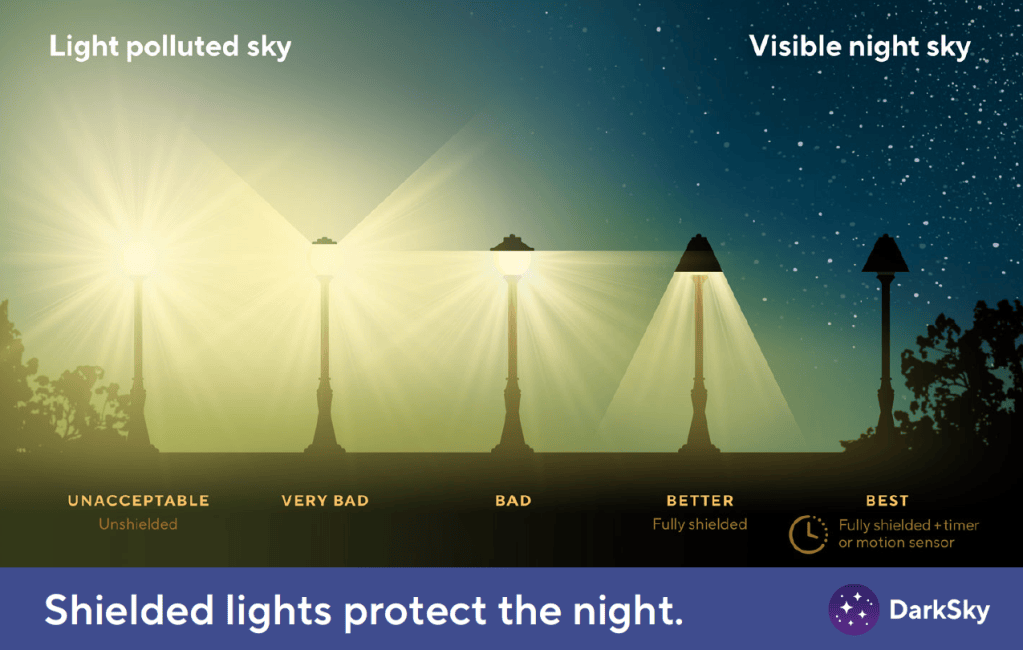
West Chester Borough has a proliferation of bad lighting, both public and private. This includes locations that were built long after West Chester instituted its lighting ordinance, which requires that “All applicants shall promote a dark sky lighting effect through the installation and maintenance of light fixtures with lights pointing down, and lighting that is shielded to prevent lighting pointing up.”
It does not take long to see that the most egregious bad light offenders are around apartment buildings and lower-income county-supported housing. These neighborhoods, where children are growing up, are flooded with damaging blue-white LED lights, often spilling onto other properties and creating glare. Such presumably well-intended safety measures may in fact make matters worse, causing deep dark shadows and causing pupils to dilate.
In West Chester, many apartment complexes are lit up at night to near daylight brightness – like those found on East Barnard and South Matlack Streets, or those at East Biddle and Maple Streets. Some of the brightest light is found surrounding the County-supported housing on East Barnard Street, an area also bathed in outrageously bright spotlights from the nearby West Chester Railway station. Families there would need to buy expensive blackout shades to aid in sleep. A newer townhome community at East Barnard and South Adams Streets installed numerous streetlight globes, all unshielded, despite the long existing Borough ordinance disallowing such lighting.
One major hurdle here is that despite there being no evidentiary correlation between darkness and crime, a majority of people believe that more light equals more safety. In fact, poorly designed light can actually mean less safety.
Still, there is some good news. These are not hard problems to fix: choose shielded, warmer color lighting for outdoor use (in the range of 2200K to 2700K). When possible, use motion sensors or timers, or turn outdoor lights out after 10 pm or before bedtime. Individuals who have inadvertently installed bright white lights that shine beyond their own property may be able to redirect the angle in which they point. (“Shielded lights protect the night,” from DarkSky.)
If it is not practical to replace your existing unshielded fixtures, replace any bright white bulbs with ones that have a warmer color temperature, and only use them when absolutely needed. When installing new lighting, choose “dark sky compliant” fixtures that are properly shielded. Talk to your friends and family about it.
Finally, if there are lights in West Chester Borough that are creating a nuisance for you, submit your complaint here. If you are outside the Borough, you might find what ordinances your town or municipality has here. Find your town, and enter the search term “lighting.”
For more information about the hazards of light at night and easy solutions, visit DarkSky International. For more on the Green Team’s Dark Skies initiative, see here and links.

